
The Arnie Risen Interview
By:
Michael D. McClellan
|
Wednesday, December 13th,
2006
A
year later, you led Ohio State to an 8-point victory over Kentucky in the
Regional Semifinals, before falling to NYU in overtime. What stands out
about that tournament?
We
had a great season, and we were very proud of how far we advanced. Beating
Kentucky was a thrill. And then we lost to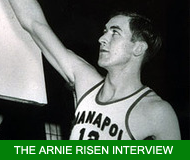 Dolph Schayes, who played on
that NYU team. Schayes was born in New York, and he had been a schoolboy
star at DeWitt Clinton High School in the Bronx. He was such a hard worker,
and a real perfectionist. He went on to a great career in the pros, and was
voted to the Hall of Fame. He was also voted as one of the NBA’s 50
greatest players of all time. It was disappointing to lose that game – I
remember that New York University made up a 10-point deficit in the closing
two minutes of regulation. We were up 62-52 when I fouled out of the game,
and NYU kept stopping the clock with substitutions and fouls. We couldn’t
hit our free throws, and that was the difference. NYU tied the game, and
then outscored us 8-3 in overtime. But we had nothing to be ashamed of as a
team – NYU put forth a fine effort, and, as I said, Ohio State competed in
three consecutive Final Fours from 1944 through 1946. I was proud to have
been a part of that success. And even though we didn’t win the
championship, it was quite an accomplishment to make it that far.
Dolph Schayes, who played on
that NYU team. Schayes was born in New York, and he had been a schoolboy
star at DeWitt Clinton High School in the Bronx. He was such a hard worker,
and a real perfectionist. He went on to a great career in the pros, and was
voted to the Hall of Fame. He was also voted as one of the NBA’s 50
greatest players of all time. It was disappointing to lose that game – I
remember that New York University made up a 10-point deficit in the closing
two minutes of regulation. We were up 62-52 when I fouled out of the game,
and NYU kept stopping the clock with substitutions and fouls. We couldn’t
hit our free throws, and that was the difference. NYU tied the game, and
then outscored us 8-3 in overtime. But we had nothing to be ashamed of as a
team – NYU put forth a fine effort, and, as I said, Ohio State competed in
three consecutive Final Fours from 1944 through 1946. I was proud to have
been a part of that success. And even though we didn’t win the
championship, it was quite an accomplishment to make it that far.
Following college, you played nearly three seasons for Indianapolis in the
National Basketball League. For the uneducated, please share what life was
like in the defunct NBL.
The
games were played at Hinkle Fieldhouse on the Butler University campus. The
players didn’t make much in the way of salary – I think the top player in
the league may have made 25 dollars per game – and that was because the
league was operating on a shoestring budget. The facilities in the league
were very crude.
The team that I played for was the Indianapolis Kautskys. It got its name from the owner, Irv Kautsky, who had made his money as a grocer. I think he was one of the first to start the big grocery stores – the forerunner to the big supermarkets that you see today. He had the first markets that actually had checkout lines. Before then, you would shop at small grocery stores and give your list to the clerk. If you wanted a loaf of bread, the clerk would go get you a loaf of bread. If you wanted a gallon of milk, the clerk would go get that. Irv helped form the National Alliance of Basketball Leagues, which later turned into the NBL. The NBL was sponsored and backed by corporations like General Electric, Firestone and Goodyear, and they would find jobs in the business for the players. And in some cases, playing basketball was the primary job for these guys. They would get paid to practice and travel, and to play league games against other industrial-based teams. It was a much different time back then. Today, the money is so big. Players travel first class, stay in first class hotels, and are treated to the best of everything. When we played it wasn’t like that at all.
You
joined the NBA Rochester Royals for the 1948-49 season. Please tell me
about the team’s legendary owner/coach, Les Harrison.
Les
was a self-made man, and a fine gentleman. He was also hard-working. A
real go-getter. I don’t believe he ever married – basketball was his life,
and we was always busy with some aspect of the game, whether it was
coaching, or promoting, or trying to find a way to get better talent on the
team. I wouldn’t say that he was the greatest coach from an X and O
standpoint, because that really wasn’t his strong suit. But he was very
passionate about the game of basketball. He was a lot like Red Auerbach in
that he knew how to surround himself with the right people, and I think that
had a lot to do with his success.
You led
the NBA if field goal percentage during the 1948-49 regular season, your
first season in a Royals uniform, and also led the team in scoring (16.6
PPG). Which player in the league was the hardest for you to score against,
and why?
Well,
I don’t really know; there was a player – I can’t recall his name at the
moment – and the reason he gave me fits wasn’t because of his height. It
was because he had a low center of gravity, and because he weighed more than
I did. He was shorter than me, but he knew how to get position and use his
size to keep me off-balance. He was a difficult match-up for me every time
out.
Of course, the premiere big man in the league at the time was George Mikan.
Mikan was the face of the league back then, the first true superstar. He
was a seven-footer, and while there were four of five others close to his
size back then, none of those players came close to his skill level as a
basketball player.
Paul Arizin was another great player back then. He played for Philadelphia,
and he was a great asset to the league and to his team – a gentleman and an
ambassador. He was the kind of person that you could really appreciate,
because he represented all facets of the game of basketball, and because he
also represented the true purpose of sportsmanship. He was one of the early
players to shoot the jump shot – he was definitely one of the better ones at
shooting it. The jump shot more or less got its start out West. But Paul
was probably one of the first Easterners who really developed it. He was
quite an institution around Philadelphia.
Harry Gallatin of the New York Knicks was another fine player. He came into
the league before there were too many seven-footers around. Back then, a
6'4" or 6'6" man could still be very effective. Harry was a real
competitor, a scrapper. He wasn't real tall, but he was strong. He was an
intelligent player and he worked hard under the boards and defensively. His
most outstanding characteristics was his rebounding. Harry was someone you
could be proud to say you knew and played against.

