
The Jerry Sichting Interview
By:
Michael D. McClellan
|
Friday, November 3rd,
2006
The first move came in the form of a trade – Boston sending forward Cedric
Maxwell to the Clippers in exchange for one-time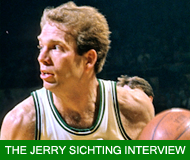 league MVP Bill Walton.
Walton had proven himself to be one of the greatest centers in the game,
until a spate of foot and ankle injuries threatened his career and reduced
him to the role of well-paid spectator. By the summer of 1985, however,
Walton was as healthy as he had been in years. He was also hungry to add
another championship to the title he had won in Portland. Walton’s arrival
in Boston meant that Parish would have a quality backup, a missing
ingredient in the team’s effort to repeat the year before. The Celtics’
bench was vastly improved by the acquisition. Still, there were concerns
about the guard play. Dennis Johnson and Danny Ainge were top shelf
starters, capable of playing both outside positions, but there was a
precipitous drop in talent beyond them. Promising collegian Sam Vincent was
drafted out of Michigan State, but a contract holdout, coupled with head
coach KC Jones’ lack of faith in rookies, sent the Celtics scrambling in
search of veteran talent. They didn’t have to look very far.
league MVP Bill Walton.
Walton had proven himself to be one of the greatest centers in the game,
until a spate of foot and ankle injuries threatened his career and reduced
him to the role of well-paid spectator. By the summer of 1985, however,
Walton was as healthy as he had been in years. He was also hungry to add
another championship to the title he had won in Portland. Walton’s arrival
in Boston meant that Parish would have a quality backup, a missing
ingredient in the team’s effort to repeat the year before. The Celtics’
bench was vastly improved by the acquisition. Still, there were concerns
about the guard play. Dennis Johnson and Danny Ainge were top shelf
starters, capable of playing both outside positions, but there was a
precipitous drop in talent beyond them. Promising collegian Sam Vincent was
drafted out of Michigan State, but a contract holdout, coupled with head
coach KC Jones’ lack of faith in rookies, sent the Celtics scrambling in
search of veteran talent. They didn’t have to look very far.
“I contacted the Celtics through Chris Ford,” Sichting says. “I was a free agent, and I had always wanted to play for the Boston Celtics. I didn’t know whether the team would be interested, but I thought that it was worth a try. There seemed to be some interest on their part, but then they drafted Sam. I really didn’t think I had a chance at that point.”
Back then, Sichting may have been surprised to know exactly how highly the Celtics valued his services. He shot the ball well, took care of it even better, and made excellent decisions with it in his hands. Boston coveted a veteran with those qualities. The team parted with Quinn Buckner via trade (to the Pacers), and then signed Sichting to an offer sheet. Fifteen days later, he was officially a member of the Boston Celtics.
The roster tweaking paid off handsomely for a Celtic team hell-bent on reclaiming the title. It took a couple of months for the team to click, but by January there was no stopping the Boston juggernaut. The winning seemed to gather momentum with each game, and Sichting, 0-2 in his only other playoff experience, could hardly contain his enthusiasm. He had not only gone from NBA doormat to championship contender, he had joined arguably the greatest collection of basketball talent the game had ever seen. Consider: So good were these Celtics that they won 43 of 49 games in one stretch, many of them by double digits. Home court domination? Try a 40-1 record at the fabled Boston Garden and at Hartford, Connecticut. (Three ‘home’ games were played in Hartford that season.) The Big Three of Bird, McHale and Parish was turning in a season for the ages, D.J. and Danny were playing championship basketball, and the bench – primarily Walton, Sichting and Scott Wedman – was producing one big play after another. The 67-15 record was a league-best that season, and one of the greatest finishes ever. The Celtics, however, had tossed up a better number in 1972-73, finishing 68-14, only to fail in its bid for a championship. In Boston, Sichting quickly learned that it was all about the bottom line. Winning 67 games would mean nothing if the Celtics didn’t win the title.
The 1986 NBA Playoffs began with the Celtics battling the Chicago Bulls and a young Michael Jordan. The hard numbers show a 3-0 Celtics sweep, but the series will be forever remembered for Game 2 in the fabled Boston Garden. That game proved to be Air Jordan’s official coming out party, a 63-point spectacle that pushed his celebrity into the stratosphere. For Sichting, winning the series was all that mattered. He had never been part of a championship team at any level. Jordan could have his points, as long as Sichting could punch his ticket into the second round, and with it a matchup against high-flying Dominique Wilkins and the Atlanta Hawks.
Boston rolled to a 3-0 series lead against the Hawks before stumbling, 106-94, in Atlanta. That loss not only delayed the inevitable, it put the veteran Celtics in a bad mood; the 132-99 Game 5 pounding was the ultimate statement game, one that erased any doubts that Boston might stumble like its 1972-73 counterparts. Sichting, after years of struggling to find success in the NBA, was halfway toward winning the ultimate prize.
“It was an unbelievable ride,” Sichting says. “We were on a roll, and everyone on the team knew that we were the best team in the NBA that year. We were extremely focused on winning the championship, and nothing was going to stop us. If anyone had any doubts, I think we proved our point after that close-out win against Atlanta.”
Milwaukee was next, but proved to be no match in the Eastern Conference Finals. The 4-0 series sweep thrust Boston back onto the world stage, where a rematch with the Lakers seemed a foregone conclusion. Sichting, along with the rest of the Celtics, expected no less. The upstart Houston Rockets, however, had other ideas; led by the twin towers, Ralph Sampson and Hakeem Olajuwon, the Rockets shocked the Lakers, 4-2, to earn its first trip the NBA Finals in five years.

