
The Sam Jones Interview
By:
Michael D. McClellan
|
Thursday, October 11th,
2007
“I knew I
was ready,” Jones says, “but in my mind, the backcourt still belonged to Bob
Cousy and Bill Sharman. They were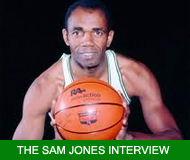 great, great players who had earned their
right to start. Replacing Bill as the starter at that point, well that was
by necessity. He was hurting and the team needed me to step up.”
great, great players who had earned their
right to start. Replacing Bill as the starter at that point, well that was
by necessity. He was hurting and the team needed me to step up.”
With Sharman retired and Jones the unquestioned starter, Boston posted a 60-20 record and earned a date with Wilt Chamberlain and the Philadelphia Warriors in the 1962 Eastern Division Finals. It was classic battle; in the thrilling seventh-game showdown, with the score tied at 107 and two seconds left, Jones hit a jump shot over the outstretched arms of Chamberlain to seal the win. After the game Chamberlain hailed Jones as the Celtics' best player. Auerbach lauded his guard’s coolness under pressure and predicted that Jones would be ready to produce further heroics if needed. The comments would prove prophetic; in the NBA Finals against the Los Angeles Lakers, Jones again came through, scoring five of the Celtics' 10 overtime points in Game 7 to propel Boston to a fourth straight NBA crown.
With Jones in his prime and his reputation as a clutch performer spreading throughout the league, it was also becoming apparent that Jones’ favorite shot – the stop-and-pop bank shot – was a deadly accurate weapon, and one of the most feared shots in the game. His quickness, intelligence and knack for finding the open spot on the court allowed him to get the shot off even when opponents tried sticking like glue.
“I started shooting the bank shot in high school,” Jones says. “I wasn’t a great outside shooter and I struggled a little making layups, so I worked on my shooting technique and I focused on using the backboard. I picked out my target and I’d shoot for hours. I got to the point where I could really trust that shot, and it helped the rest of my game.”
And about that knack for seemingly always being in the right place at the right time?
"You simply can't stand still," he explains. "When the ball is shot, the defender has to turn his head to see where the rebound is going. When I see we have the rebound, I immediately go to another position on the court. The man who is guarding me has his back to me now and he doesn't know I've moved. He has to turn around and look for me. It doesn’t have to be much. Just an opening. That’s all you need, because you only need a split second to get a shot off."
The Celtics would win the titles in 1963 and 1964, giving them six consecutive championships and cementing their status as a dynasty. Jones scoring average continued to climb as well, as he, along with John Havlicek, became the focal points of the offense. The retirement of Bob Cousy following the 1962-63 season also ushered in a new era in the Boston backcourt, and one with a distinct defensive feel. Cousy, replaced in the starting lineup by defensive specialist KC Jones, could only marvel at the quality of play exhibited by the duo nicknamed “The Jones Boys”.
“It was a great pairing,” Cousy says. “It gave Arnold [Auerbach] a different dimension that what he had with me and Sharman, and he knew how to coach to their strengths. It helped keep the championships coming, that’s for sure.”
Jones averaged a career-high 25.9 PPG during the 1964-65 season, good enough for fourth in the league, and landed in the NBA All-Star Game for the third time in his career. Noteworthy to be certain, but statistics and individual accolades were of little concern. Sam Jones was a team player who shared Russell’s singular desire to win it all, all the time.
"Scoring averages don’t mean a thing, " he says. "Making the All-Star team, and being named All-NBA, those things don’t mean a thing either. Every guy on those Celtic teams had the ability to lead the team in scoring if that's what he was asked to do. But we all had a role to play. We all knew what was expected of us, and what each of us had to do in order to win the championship. It was the most unselfish group of people I’ve ever been associated with. It’s also why I didn’t want to be inducted into the hall of fame without my teammates. To me, what we did wasn’t about one person. It was only about Bill Russell or Sam Jones. It was about the entire team, the roles we played, and the sacrifices that we made in order to achieve something bigger.”
The Celtics continued sacrificing and kept right on winning, adding two more titles to the coffer before Auerbach bowed out as head coach following the 1965-66 season. Rumors swirled as to who would take over the reins, but in Auerbach’s mind there was only one other man who could coach the great Bill Russell: Russell himself.
“Great choice,” Jones says without hesitation. “Russell was at the perfect point in his career to coach the Boston Celtics. It was a veteran team, a close team, and we were all focused on championships. That was all that mattered.”
Russell’s first season as player/coach ended in disappointment, as the Celtics succumbed 1-4 to Wilt Chamberlain and the eventual champion Philadelphia 76ers. Jones played well throughout, leading the team with a 22.1 PPG scoring average, and although he failed to make the All-Star Team for the first time in four years, Jones was named to the All-NBA Second Team. The Celtics, meanwhile, were viewed by many as too old to challenge for another championship. They proved the experts wrong by winning it all in 1968 and repeating in 1969, with Jones playing a huge role in Game 4 of that ’69 series against the Los Angeles Lakers. Behind by one point with seven seconds remaining, the Celtics called a timeout and Russell didn’t hesitate in choosing the player to take the game-winning shot. When Jones found the ball in his hands, he did what he always did best.
"I knew that last shot was good from the moment it left my hand," Jones says, smiling. "There never was any doubt because I had time to release the shot properly, and I trusted my technique completely. That took the pressure off. The ball rolled right over the cylinder. We won that game, and then we went on to win the championship."
The ’69 championship gave Russell 11 titles in 13 seasons, while Jones finished with 10 in 12. Both retired as two of the greatest legends to ever wear a Boston Celtic uniform. Perhaps the greatest compliment anyone paid to Jones was supplied by Auerbach at a special ceremony at Boston Garden. "I would like to thank Sam Jones," he said at the time, "for making me a helluva coach."
In 1970, Jones was named to the NBA 25th Anniversary All-Time Team, and in 1983 he was elected to the Naismith Memorial Basketball Hall of Fame. In 1996, Jones – Mr. Clutch to you – was further honored by being named to the NBA 50th Anniversary All-Time Team.
Celtic Nation is honored to bring you this interview.

