
The Greg Kite Interview
By:
Michael D. McClellan
|
Tuesday, January 3rd, 2012
You grew up in Houston, Texas. Please tell me a little about your childhood – the sports you liked to play, the schools you went to, and what led you to the basketball court.
I was
the youngest of four kids – I had one brother and two sisters. My parents moved
to Houston in 1952, not long after they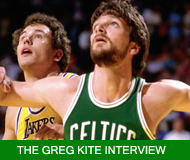 were married, and I was born in 1961. My
dad worked for Exxon, but it wasn't Exxon at the time, it was actually called
Humble Oil Company. He was a big sports fan. My brother was five years older
than me, and he played football, basketball, baseball. I always tagged along
with him and wanted to play the sports he played. So I played little league
baseball and football, and did some things in track, and we had a lot of other
kids in the neighborhood who played all of those sports, too. We played a lot of
pickup games around our house.
were married, and I was born in 1961. My
dad worked for Exxon, but it wasn't Exxon at the time, it was actually called
Humble Oil Company. He was a big sports fan. My brother was five years older
than me, and he played football, basketball, baseball. I always tagged along
with him and wanted to play the sports he played. So I played little league
baseball and football, and did some things in track, and we had a lot of other
kids in the neighborhood who played all of those sports, too. We played a lot of
pickup games around our house.
I played on my first basketball team when I was 10 years old at the Southwest
YMCA in Houston. From there I went on and played junior high ball at Pershing
Junior High, seventh through ninth grades, and then went on to play three years
of basketball at Madison High School. My brother did the same thing before me,
so the high school coaches were familiar with our family and who I was. I was
always hanging around my brother, so the coaches wanted to know who this big kid
was that kept showing up.
Growing up in Houston was a great basketball environment. When I was a kid, the
University of Houston had some great basketball players. Elvin Hayes jumps to
mind, who was one of the greatest players in the history of the college and pro
games. Later they had guys like Otis Birdsong and Dwight Jones. So that was a
strong influence on me, because in high school I'd get to play with a lot of
those guys in the summer. And then you had the Houston Rockets coming to town in
the early '70s, as they relocated from San Diego, and that just spawned a whole
generation of players like Clyde Drexler, who was from Houston, and Rob
Williams, who as a top pick from the University of Houston. He was a 25-point
per-game scorer with the Nuggets before he got into drugs.
In some ways it was surreal, because I grew up watching Elvin Hayes and ended up
playing against him before he retired. He was one of my favorite all-time
players, and then during my rookie season with the Celtics he was at the end of
his NBA career and I got to guard him. That was a special moment for me.
You went to Madison High School in Houston, what memories stand out about your high-school career?
My brother was 6'5” and was a good player at
those levels. He played football and was
good at that, too, but he hurt his back
during his eleventh grade season and didn't
play anymore football after that. I stopped
playing football after my ninth grade
season, and then played some organized
baseball outside of school. I was about
6'10” tall when I was 15, playing in the
baseball all-star game, and when I struck
out three times chasing curve balls I
realized baseball wasn't my game. So that
was the end of that. I learned later that
the pitcher went on to become a pretty good
pitcher for Texas A&M, so it wasn't like I
was getting smoked by a bad pitcher
[laughs].
I loved playing the other sports and in some
respects wished I had continued, but I was
so focused on playing college and pro
basketball that I decided to specialize. The
other seasons overlapped too much, and I
didn't want to miss any of the basketball
season.
It was a great team atmosphere, great
camaraderie. We had an excellent coach in
Paul Benton, who is now a member of the
Texas High School Basketball Hall of Fame.
He won over 800 games during his coaching
career, and he was a very good teacher of
the game.
We never won the state championship, but we
had a lot of great players in that program.
During my senior year Basketball Weekly
had us ranked as high as 5th in the nation.
In 1979 we were ranked number 1 in the whole
state for the entire year. We were 39-0, but
we lost in the state semifinals to Lufkin
High School from Austin, Texas. That was the
most disappointing time of my whole high
school career.
In Texas you have hundreds of schools to
fight through at all of the levels, so
looking back on it now it was quite an
accomplishment. We had 8 guys on that team
who went on to play college basketball, and
one who went on to play football at Alabama.
I ended up playing college ball at BYU, one
of the guys played at Oklahoma, one played
at LSU, one played at Houston Baptist. So we
had a lot of talent on that team. We were
well-coached, moved the ball well, played
really good defense. It was just that
disappointment of not making it to that
finals that stands out.
Take me back to your career at BYU: The 79-80 WAC Conference Championship Team had four future NBA players, three of whom would go on to play for the Celtics: Danny Ainge, Fred Roberts and Greg Kite. Please tell me a little about that team, and also about Danny and Fred.
I had a lot of choices of schools to go to,
and was recruited by some of the biggest in
the nation. UCLA, Kentucky, Texas, Houston
and Duke to name a few of my final choices.
They were all good schools with great
basketball programs, but I felt that going
to BYU was the right decision for me. Not
only athletically, but socially,
academically and spiritually. If I wasn't
playing basketball and it was strictly a
school choice, I would have probably gone
there anyway.
It wasn't an easy decision, but my mother
had actually gone to school there. She
finished at Kansas, but she went there, as
so did her sisters. My older siblings went
there as well, so we had something of a
family tradition at BYU.
Danny Ainge was a star at the school, and
our head coach at the time was Frank Arnold.
Frank was very knowledgeable, a great
basketball mind. He'd been an assistant to
John Wooden at UCLA during the teams 88-game
winning streak. He brought a lot of the same
teaching principals and discipline that they
used at UCLA.
Before Coach Arnold arrived, the BYU
basketball program had been mediocre during
the '70s. Coach Arnold, along with Danny,
really helped to revive the program. There
were other talented players in the program
as well. Fred Roberts was a year ahead of
me, and Devin Durrant was also there – Devin
played NBA ball, too. We had a lot of guys
who were signed to play overseas as well, so
we had some talent at BYU when I played.
We went to the NCAA Tournament during my
first two years there, with Danny leading
the way. Danny's senior year – my sophomore
year – we went the deepest, making it all
the way to the Elite 8 before losing to
Ralph Sampson and the Virginia Cavaliers.
The game before that, Danny had that famous
full-court dash to the basket against Notre
Dame, dribbling past Kelly Tripucka and John
Paxson, and putting in that scoop layup
around Orlando Woolridge for the win. It's
still one of the most memorable plays in
college basketball history, but what people
don't remember about that play is that Steve
Trumbo and I were both wide open underneath
the basket but Danny shot it anyway. That's
Danny for you, Danny always shot it
[laughs]. No, Danny made the right decision
to take the ball to the basket.
It was a great college experience for me, no
question about it. But in some ways I feel I
may have underachieved from a basketball
standpoint, especially when I compare it to
my high school career and where I was at
that point in terms of accomplishments, but
I have no regrets. I enjoyed playing
basketball at BYU and wouldn't have wanted
to play anywhere else.

