
The Jerry Sichting Interview
By:
Michael D. McClellan
|
Friday, November 3rd,
2006
He was like any other Indiana schoolboy of the day, a sports junkie spending
countless outside hours bouncing between the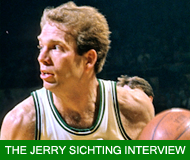 diamond, the court and the
gridiron, always playing some sort of ball, the folklore in his state filled
with stories of Knute Rockne and Notre Dame football, and of Bobby Plump and
the miracle Milan basketball team that later inspired the movie Hoosiers,
his dreams bigger than the outlandish feats of Indiana legends John Wooden
and Oscar Robertson, men who would revolutionize the very sport he would
come to love above all the rest. He was like the other boys in other ways
as well; neither particularly fast, nor especially big, he hardly seemed the
sort who would hang in a league boasting the best athletes in the world,
much less do so for ten seasons while playing an integral part on arguably
the greatest team in the history of the National Basketball Association.
Yes, Jerry Lee Sichting was average in many ways – nondescript, by most
accounts – but there was also something very special about this gritty guard
with heart, smarts and moxie. He was an overachiever cut from his first
professional team, filling time by working the floor of a sporting goods
store, confident that he could stick if the right opportunity came along.
He was a fighter who refused to let a young Bobby Knight submarine his Big
Ten aspirations, proving his critics wrong by attending Purdue and earning
all-conference honors as a senior. And he was, perhaps above all else, a
producer – of points, assists and steals to be certain, but there was far
more to him than mere numbers on a page. Sighting was the epitome of all
those unselfish, team-first players who ever laced up their sneakers in
pursuit of the Indiana dream, his place on the 1985-86 NBA Champion Boston
Celtics a product of his dogged determination and perseverance.
diamond, the court and the
gridiron, always playing some sort of ball, the folklore in his state filled
with stories of Knute Rockne and Notre Dame football, and of Bobby Plump and
the miracle Milan basketball team that later inspired the movie Hoosiers,
his dreams bigger than the outlandish feats of Indiana legends John Wooden
and Oscar Robertson, men who would revolutionize the very sport he would
come to love above all the rest. He was like the other boys in other ways
as well; neither particularly fast, nor especially big, he hardly seemed the
sort who would hang in a league boasting the best athletes in the world,
much less do so for ten seasons while playing an integral part on arguably
the greatest team in the history of the National Basketball Association.
Yes, Jerry Lee Sichting was average in many ways – nondescript, by most
accounts – but there was also something very special about this gritty guard
with heart, smarts and moxie. He was an overachiever cut from his first
professional team, filling time by working the floor of a sporting goods
store, confident that he could stick if the right opportunity came along.
He was a fighter who refused to let a young Bobby Knight submarine his Big
Ten aspirations, proving his critics wrong by attending Purdue and earning
all-conference honors as a senior. And he was, perhaps above all else, a
producer – of points, assists and steals to be certain, but there was far
more to him than mere numbers on a page. Sighting was the epitome of all
those unselfish, team-first players who ever laced up their sneakers in
pursuit of the Indiana dream, his place on the 1985-86 NBA Champion Boston
Celtics a product of his dogged determination and perseverance.
Born and raised in Martinsville, Indiana, Sichting began sports at a very early age. Martinsville City Park abutted the family property line, and it wasn’t long before Sichting found himself on the park’s basketball court, hoisting shots in all manner of weather. While the park provided countless hours of entertainment, it also provided the inspiration Sichting needed to excel. He would often play alone, creating imaginary games in his mind, but there were many times when the court would be filled with other boys, many of them connected to Martinsville’s junior high and high school teams. State champions in 1924, 1927 and 1933 – John Wooden was a star on that ’27 title team, as well as the state runner-up teams of ’26 and ’28 – Martinsville High School was a source of immense civic pride for this small town and its neighboring communities. Sichting would go to the games as a pre-teen, and he would play pickup games with many of the team’s players during those hot, lazy days of summer. Soon, he would find himself at the center of the hysteria; Sichting started all four years for Martinsville High, as new head coach Sam Alford built the program around underclassmen, and he also excelled at quarterback on the football team.
Martinsville’s basketball team, on a downswing for nearly a decade, experienced a rebirth of sorts during Sichting’s junior and senior seasons. Faced with the daunting, one-class tournament that had made legends out of Plump and his teammates, Martinsville, a small school in its own right, was able to advance into the later rounds before succumbing to bigger, stronger teams. The city treated the team like stars. The turnaround on the football field was equally dramatic, as Martinsville lost only two regular season games in a three year span. Sichting was talented enough to earn all-state honors while generating cursory interest from Notre Dame and its outgoing head coach, Ara Parseghian. The allure of South Bend was tempting, but Sichting understood that football wasn’t where his athletic future lay. He was going to be a basketball player. Could feel it in his gut. Besides, the Fighting Irish already had a hot, young recruit in a fellow named Joe Montana, so a young Jerry Sichting wisely hung up his cleats and opted to pursue his first love.
His athletic path settled, several major colleges expressed an interest in the tough-as-nails guard with the sweet shooting stroke. It was an impressive list that included Indiana University and its brash head coach, Bobby Knight – at least until the Hoosiers rescinded the scholarship offer, forcing Sichting to look elsewhere. He signed with Purdue, following the footsteps of the great Wooden. Motivated by Indiana’s perceived disrespect, Sichting embraced West Lafayette and proved he belonged in the world of Big Ten basketball, transforming himself into an all-conference standout by the end of his senior season.
The NBA Draft was a completely different animal back then – more rounds, less fanfare – and Sichting’s fourth round selection by Golden State was met with little celebrity outside of Martinsville. He packed his bags and headed west, holding his own in veterans camp but getting the axe after head coach Al Attles settled on a season-opening roster that included guards John Lucas, Phil Smith and former Celtic Jo Jo White. Set adrift, Sichting tried CBA basketball for two days, before returning to Indiana and taking a job in a sporting goods store. He stayed in the game by playing in leagues around Indianapolis, his confidence unbowed, his heart convinced that he could play NBA basketball. The problem: Few NBA executives believed likewise. The 1979-80 season came and went without so much as a phone call, and by the following summer Sichting was wondering whether he would ever get the chance to prove he belonged. That chance would come in the form of open tryouts with the Indiana Pacers, a “Walter Mitty Camp” that promised the public a shot at a roster spot on what was then a floundering franchise. Sichting was hardly in playing shape, but he was impressive enough to earn a spot on the team’s summer league roster – and, in the process, earn an invitation to veterans camp. Almost improbably, he made the team.
The Pacers were decent during the 1980-81 NBA regular season, going 44-38 with a roster that included an aging George McGinnis and an unproven Jerry Sichting. The record was good enough to make the playoffs, where the team fell in the opening round to Dr. J and the Philadelphia 76ers. A year later the Pacers were 35-47, and out of the playoffs entirely. Indiana was positively dreadful during the 1982-83 season, going 20-62, but Sichting was solid as the team’s starting point guard, averaging 9.6 points and 5.3 rebounds, and playing well enough to earn a starting nod on occasion. A 26-56 season followed in 1983-84, and a year later the team was 22-60. For Sichting, just making an NBA roster was no longer the priority. He had scrapped and clawed his way into the league, and he had proven himself as a key reserve coming off of the bench. He had also observed the great things happening in Boston, where another Indiana schoolboy was busy setting the world on fire. Larry Bird had transformed the Celtics into perennial championship contenders, winning it all in 1980-81 and again in 1983-84, only to see the hated Los Angeles wrest the crown in 1984-85. The Celtics were loaded with talent, especially with a starting lineup that included Bird, Kevin McHale and Robert Parish, but the team sorely lacked depth. Something had to be done if Bird and his mates were to keep pace.

